ENERGY & BUILDING-CODE COMPLIANCE · SAN FRANCISCO, CA, USA (HYPOTHETICAL SITE; TITLE 24 CZ 3, ASHRAE 3C)
San Francisco Office Energy & Compliance
The WF1 London office (single storey, 756 m² conditioned) was re-assessed as if built in San Francisco without changing its geometry. Hexanta ran code pre-checks, design loads, PV/battery sizing and design options offline, and drove the native IESVE 2026 Title 24 2025 performance workflow end-to-end twice. IESVE reported 'complies' both times; Hexanta's engineering review rejected both results because the margin is dominated by Standard-design fan energy. The official report, PV/SARA and the ASHRAE 90.1 PRM were not completed before the trial licence expired.
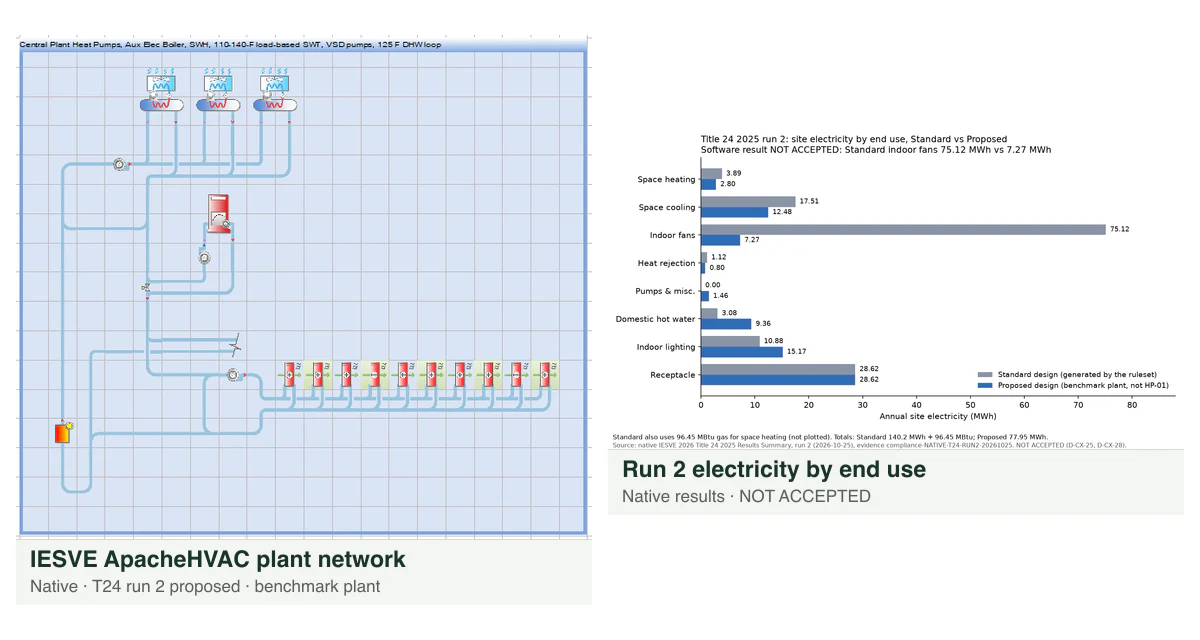
Native Title 24 2025 workflow automated end-to-end in IESVE; software 'complies' result rejected on engineering review
Native T24 runs
2 (both rejected)
Fan share of run 2 margin
94.5 % (≈3 % without)
Proposed EUI
90.2 kWh/m²·yr (not accepted)
PV needed
≥ 21.1 kWdc (offline)
- Discipline
- Energy & building-code compliance
- Location
- San Francisco, CA, USA (hypothetical site; Title 24 CZ 3, ASHRAE 3C)
- Building
- Office (synthetic — WF1 London Run 4 building relocated)
- Stage
- Design validation (provisional)
- Verification status
- NOT COMPLIANT / NOT ACCEPTED — native Title 24 runs rejected; official report not generated; ASHRAE PRM blocked
- Engineering approval
- OUTSTANDING — no compliance certification or engineer approval
Objectives
- Re-assess the WF1 building for San Francisco (Title 24 2025 CZ 3, ASHRAE 3C) without changing geometry
- Run Title 24 2025 prescriptive pre-checks, ventilation, PV and battery sizing offline with traceable rules
- Drive the native Title 24 2025 performance workflow in IESVE and review its result independently
- Prepare the ASHRAE 90.1-2019 Appendix G PRM (LEED v5) route
- Route every result to qualified-engineer review; claim nothing the evidence does not support
Overview
No Title 24 certification or compliance PASS is claimed. IESVE printed 'This design DOES comply with Title 24 - 2025 compliance methodology' for both native runs; both were NOT ACCEPTED on engineering review (D-CX-24, D-CX-25, D-CX-28). The official compliance report (PRF-01) was not generated and the ASHRAE 90.1 PRM was blocked by licence expiry. Engineering approval: OUTSTANDING.
Brief
Re-assess the synthetic WF1 London office as if built in San Francisco, keeping geometry unchanged: code pre-checks, design loads, PV and battery sizing, design options, and native IESVE Title 24 2025 and ASHRAE 90.1-2019 PRM runs, all routed to engineer review.
Code editions
- California energy code
- Title 24 Part 6, 2025 edition (nonresidential), performance and prescriptive routes
- ASHRAE
- 90.1-2019 Appendix G PRM (+ addendum cr) for LEED v5 EAp2 Option 1; engine rules packs also exist for 90.1-2016 and 90.1-2022 (no 2022 mode in VE 2026)
- LEED
- LEED v5 BD+C Energy & Atmosphere — blocked (needs PRM results)
- San Francisco local
- 2025 local requirements (all-electric, Green Building Code energy items) — blocked
- Climate
- Title 24 climate zone 3; ASHRAE 169 zone 3C
Verification summary
11 recorded results · 8 from the native tool · 1 PASS · 4 PARTIAL · 2 FAIL · 3 BLOCKED · 1 NOT TESTED
Native evidence and completeness matrix → Verified downloads →
Engineering findings
- The complete native Title 24 2025 performance workflow (templates, building data, CEC construction mapping, Standard model generation, Proposed and Standard annual simulations, Results Summary, battery step) was driven end-to-end in IESVE 2026 on the synthetic San Francisco scenario.
- IESVE reported 'This design DOES comply with Title 24 - 2025 compliance methodology' in both runs; Hexanta's review rejected both (D-CX-24, D-CX-25, D-CX-28).
- Run 2: 94.5 % of the 47.11 $/ft²·yr LSC margin comes from Standard indoor fans (75.12 vs 7.27 MWh; about 7,640 equivalent full-load hours against 5,818 h availability); about 3 % margin without it. To be confirmed against the 2025 nonresidential ACM manual or with the software vendor.
- Automated plausibility triggers (unmet hours > 150, fan EUI > 40 kWh/m²·yr, Standard/Proposed fan ratio > 3, one end use > 60 % of margin) now stop any navigator 'complies' result from being accepted on its own (D-CX-25).
- The run 1 diagnosis found an unserved plantroom treated as conditioned (151 unmet heating hours) and a non-WF1 water-cooled chiller; run 2 corrected both (plantroom unoccupied, D-CX-27; code-minimum benchmark heat pump, D-CX-26).
- The earlier finding 'Title 24 2025 module not installed' was withdrawn: the module is built into VE 2026 (D-CX-19).
- Offline pre-check: failed_precheck on fenestration solar heat gain, lighting power (9,864 W vs 5,480 W allowed) and missing PV (≥ 21.076 kWdc) and battery (≥ 37.522 kWh / 9.381 kW).
- Native and Hexanta design loads agree within 7.5–8.5 % (heating ratio 0.925, cooling 1.085); these are agreement checks, not validation.
Conclusions
- Hexanta drove the complete native Title 24 2025 performance workflow in IESVE 2026 end to end, twice, on a synthetic building at a hypothetical San Francisco site.
- Both software 'complies' results were NOT ACCEPTED on engineering review: 94.5 % of the run 2 margin comes from Standard-design indoor fan energy, about 3 % without it. No Title 24 compliance, pass or certification is claimed.
- Automated plausibility triggers now stop a navigator 'complies' result from being accepted on its own; the official compliance report (PRF-01), PV/SARA and the ASHRAE 90.1 PRM were not completed before the IESVE trial licence expired.
Limitations
- The building is synthetic (WF1 London Run 4 relocated) at a hypothetical site; permit date assumed 2026-11-02.
- HP-01 has no certified ratings; the proposed plant is a code-minimum benchmark; heating heat pumps autosized (oversized vs room heating 10.6 kW).
- Glazing data are European (EN) values, not certified US ratings; DHW design unresolved; air barrier, controls, commissioning and lighting controls not assessed.
- PV/SARA, PRF-01 and the ASHRAE PRM were not completed; the IESVE trial licence expired 2026-10-25 and no native run was attempted for this pack.
- Standard design fan energy (75–81 MWh) remains unexplained; Standard unmet heating hours read 21 (Results Summary) and 24 (plausibility check) without explanation.
- The offline energy model is quasi-steady (no thermal mass; fans at code limits as targets; pumps and DHW unresolved; annual-average carbon factor); all offline energy figures are PRELIMINARY.
- Title 24 / SF values in the engine are transcribed and unverified; licensed ASHRAE tables are not held; the CZ2022 weather set is named but not shipped (licence not stated).
- The offline study r4 predates the native runs; its text does not yet reflect them.
What this case study does not claim
- No Title 24 compliance, pass or certification: the software 'DOES comply' statements were NOT ACCEPTED (D-CX-24, D-CX-28) and no PRF-01 exists.
- No '59.95 %' or '64.82 %' (or any) better-than-code margin: 94.5 % of the run 2 margin is Standard fan energy; about 3 % without it.
- No ASHRAE 90.1 PRM / PCI result, no LEED v5 points or rating.
- No San Francisco all-electric or energy-budget compliance (both blocked).
- Not a verified, validated or engineer-approved design; inputs are synthetic and provisional; the proposed plant is a benchmark, not HP-01.
- Not a real San Francisco project or site (synthetic WF1 London building at a hypothetical site, provisional ZIP).
- No native PV simulation or solar-access (SARA) assessment; offline PV yields are PRELIMINARY.
- The native battery step is not part of any compliance result (Results Summary shows battery 0).
- The offline options (EUI 104.4 → 89.0 kWh/m²·yr, grid import and carbon reductions) are PRELIMINARY estimates, not simulations or compliance results.
- Hexanta is not CEC-approved compliance software and does not replace it; native/offline comparisons are agreement checks only.
- No cost savings, payback or tariff-based figures (LSC $/ft²·yr is a Title 24 metric, not a cost).
- No partnership or endorsement by any equipment manufacturer; third-party battery data are public datasheet values.
- No current IESVE availability or commercial licence: the work used a trial licence that expired 2026-10-25.
- Compliance results are not computed live in the Hexanta application; this is a read-only case study of preserved evidence.
Sanitised derivative of preserved evidence (compliance-* evidence folders, branch feat/compliance-engine). Nothing was re-simulated for this pack; IESVE was not started. Screenshots are cropped and reviewed; plots and the report contain only values read from the evidence. Not a compliance document. · Pack sf-office-compliance-r2 (built 2026-10-25); every file is checked against its SHA-256 before it is shown.