FIRE ENGINEERING — EVACUATION (EGRESS) MODELLING · LOS ANGELES AREA, CALIFORNIA, USA (HYPOTHETICAL SITE)
Los Angeles Hotel Fire Evacuation
Night-time wildfire evacuation of a hypothetical cabin-court hotel, run natively in IES Simulex by Hexanta automation: 5 scenarios × 3 runs. With the assumed inputs, an earlier staff warning cut the mean evacuation time from 886.5 s to 318.2 s (−64 %), while layout changes stayed within run-to-run randomness. Hypothetical building and scenarios on synthetic assumptions; not professionally approved.
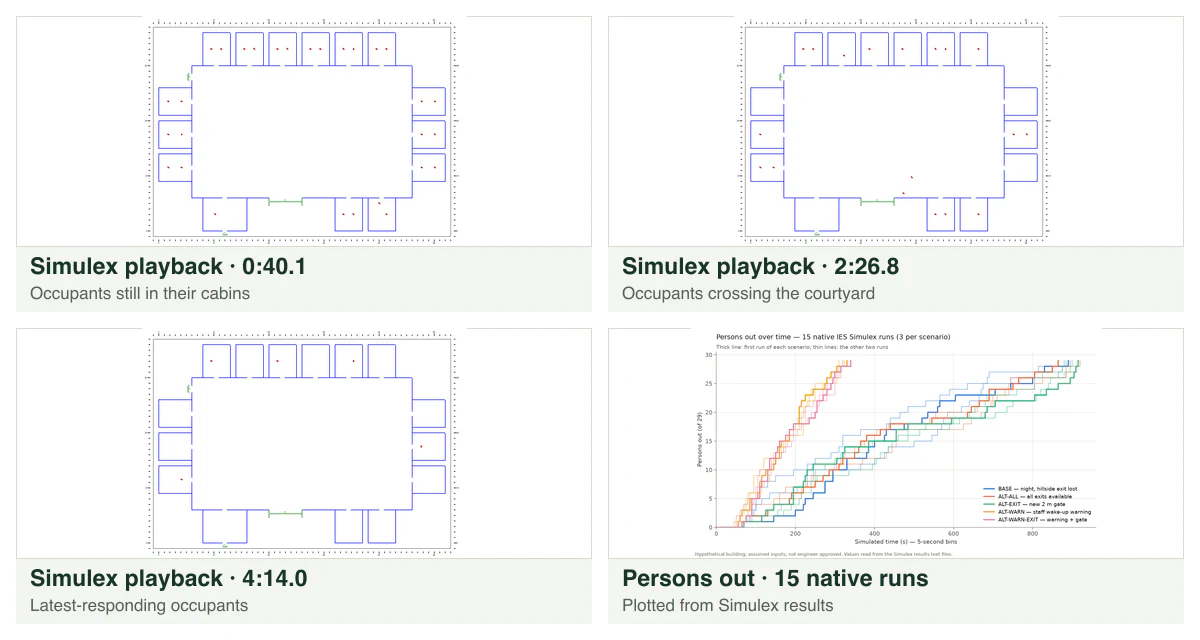
Earlier warning cut mean evacuation time by 64 % in native Simulex runs (assumed inputs)
Baseline mean
886.5 s
Staff warning mean
318.2 s
Hotel runs
15 (3 per scenario)
Occupants
29 (assumed)
- Discipline
- Fire engineering — evacuation (egress) modelling
- Location
- Los Angeles area, California, USA (hypothetical site)
- Building
- Hotel (hypothetical single-storey cabin-court hotel: 15 guest cabins, 29 occupants)
- Stage
- Concept study (assumed inputs)
- Verification status
- NATIVE SIMULEX RESULTS (17 runs) — inputs assumed; CP1–CP4 NOT APPROVED; no ASET/fire model
- Engineering approval
- OUTSTANDING — not professionally approved; no life-safety or AHJ approval
Objectives
- Run a native evacuation study end to end with Hexanta automation of IES Simulex
- Compare a night baseline with layout and operational alternatives
- Separate solver output from derived statistics and unverified code checks
- Show the same engine on a second building geometry
Overview
Hypothetical Los Angeles-area hotel evacuation study based on synthetic assumptions. The building, site, occupants and evacuation scenarios are hypothetical; it is not a model of any real building or event. Results are not professionally approved and are not evidence of code compliance or life safety.
Hypothetical building. This is a hypothetical 15-cabin cabin-court hotel created for the study; it is not a model of any real building and makes no statement about any real event. Every dimension, occupant number, response time and walking speed is an assumed study input. Not engineer approved; not evidence of code compliance; no life-safety or AHJ approval.
A night-time evacuation study of a hypothetical single-storey cabin-court hotel (15 detached guest cabins around an open courtyard, 29 occupants) in a wildfire setting. Hexanta prepared the model, ran IES Simulex natively by user-interface automation (no operator input), parsed the solver's results files and compared a baseline with layout and operational alternatives. Five scenarios were run three times each (15 runs); a second hypothetical building (an office) was run twice to test that the same engine handles another geometry. Nothing was re-simulated for this case study.
- Native runs
- 17 (15 hotel + 2 office), IES Simulex, 2026-10-24
- Occupants (hotel)
- 29 (assumed)
- Baseline mean
- 886.5 s (3 runs)
- Staff warning mean
- 318.2 s (3 runs), −64 %
- Engineering approval
- OUTSTANDING — CP1–CP4 NOT APPROVED; no life-safety or AHJ approval
Verification status: NATIVE SIMULEX RESULTS (17 runs) — inputs assumed; CP1–CP4 NOT APPROVED; no ASET/fire model. 'Native' means the numbers come from Simulex's own results files, whose hashes were re-checked; it does not mean the inputs or conclusions are validated.
Verification summary
12 recorded results · 8 from the native tool · 9 PARTIAL · 3 NOT TESTED
Native evidence and completeness matrix → Verified downloads →
Engineering findings
- Pre-movement (response) time governs in this model: every run's total is close to the upper limit of the assumed response-time range (60–900 s scenarios: totals 864.4–917.2 s; 30–300 s scenarios: totals 309.3–335.2 s). The Simulex results text does not report each occupant's drawn response time, so the walking time after the last response cannot be measured from the output; the study's rule-based note ("movement after the last occupant responds is about 0 s") compares the mean with the range limit, not with the drawn maximum, and is not repeated here as a measurement.
- Earlier warning had the largest measured effect: ALT-WARN mean 318.2 s vs BASE 886.5 s (−568.3 s, −64 %); the run ranges do not overlap. This is a result of the assumed response-time ranges, not a measured human response.
- Layout changes were within run-to-run randomness: ALT-ALL (+11.2 s) and ALT-EXIT (+11.3 s) vs BASE, and ALT-WARN-EXIT vs ALT-WARN (+5.9 s), with overlapping ranges. More exits did not shorten the total because the total is set by the latest responder.
- Exits were far from queueing: the highest Hexanta-derived peak specific flow is about 0.47 person/(s·m) (2 persons in one 5-second bin through the 0.86 m office door X4, ALT-WARN-EXIT; the study report rounds it to 0.46), against the 1.3 queueing indicator used by the analysis.
- Reopening a saved Simulex project and running it again reproduced the result exactly (10 reruns), so the spread comes only from independent builds (new random response draws), three per scenario.
- The same engine and Simulex driver ran a second hypothetical building (corridor office, 42 occupants): 103.5 s with both exits, 105.2 s with the east exit blocked — one run each, difference not distinguishable from randomness.
Conclusions
- Hexanta automation ran a native IES Simulex evacuation study end to end: 15 hotel runs (5 scenarios x 3 independent builds) and 2 office engine-test runs, each checked by the driver.
- With the assumed response-time ranges, an earlier staff warning had the largest effect (mean 318.2 s vs 886.5 s, -64 %); layout changes stayed within run-to-run randomness and exits were far from queueing. These are results of assumed inputs, not measured human behaviour.
- There is no fire or smoke model, so no ASET or safety margin; checkpoints CP1-CP4 are NOT APPROVED and no life-safety or AHJ approval is claimed. The building is hypothetical.
Limitations
- Hypothetical building and assumed inputs: response times and speeds are development placeholders that a fire engineer must set; the population (29) is assumed.
- Simulex's own occupant types replaced the scenario walking speeds (a hotel population mix; a disabled type stands in for a wheelchair user — Simulex has no wheelchair body type).
- Single storey; no stairs; no furniture or obstructions; distances end at the site exits, not at a public way or assembly point; no site roads or vehicles.
- No fire, smoke or wildfire-exposure model: no ASET and no safety margin.
- Exit times are known only to Simulex's 5-second bins; per-occupant times, densities and congestion are not in the Simulex output.
- Three independent builds per hotel scenario and one per office scenario: small samples.
- Code checks and the hand estimate are Hexanta calculations on parameters NOT VERIFIED against the adopted code text; the AHJ is not identified or engaged.
- Engineering checkpoints CP1 (inputs), CP2 (native run), CP3 (alternatives) and CP4 (issue) are all NOT APPROVED.
- No further Simulex runs are possible at present (the solver licence has ended).
What this case study does not claim
- Not professionally approved: no fire engineer, life-safety or AHJ approval of the building, the scenarios or the results.
- Not a real hotel or real building, and not a model or reconstruction of any existing or former building.
- No statement about any real fire, any real evacuation, or the cause of any fire.
- No code compliance, permit readiness, AHJ approval or engineer approval.
- No safety margin, survivability or lives-saved claim (no ASET, fire or smoke model).
- Inputs (population, response times, speeds) are not real or validated data.
- Congestion, density and per-occupant times are not Simulex outputs.
- No claim that the new gate or more exits improves evacuation; the measured differences are within randomness.
- The −64 % applies only to this hypothetical model and its assumed response-time ranges; it is not a general effect of warnings.
- No measurable effect is claimed for the office test (one run per scenario).
- No endorsement by, or partnership with, the solver vendor; no Simulex API integration (Hexanta drives the Simulex user interface).
- No claim that new Simulex runs can be made now (licence ended).
- Not validated against real evacuations; 'verified' refers only to the provenance of solver output files.
- The evacuation engine is not a live product feature; this is a case study from preserved evidence.
- The prescriptive checks are not a compliance determination.
Sanitised derivative of preserved evidence (simulex-HXM01-20261024, simulex-HXO01-20261024-r2, simulex-JOB-20261024). Plots and the report were drawn by Hexanta from values in the Simulex results files; screenshots are cropped and visually reviewed. Nothing was re-simulated. · Pack la-hotel-evacuation-r3 (built 2026-10-25); every file is checked against its SHA-256 before it is shown.